
WITHOUT YOUR PERMISSION
Five investigations. One question. When did anyone ask you?

Questioning the infrastructure being built around your life.
Each part stands alone. Together they tell you something nobody has laid out in plain language before.
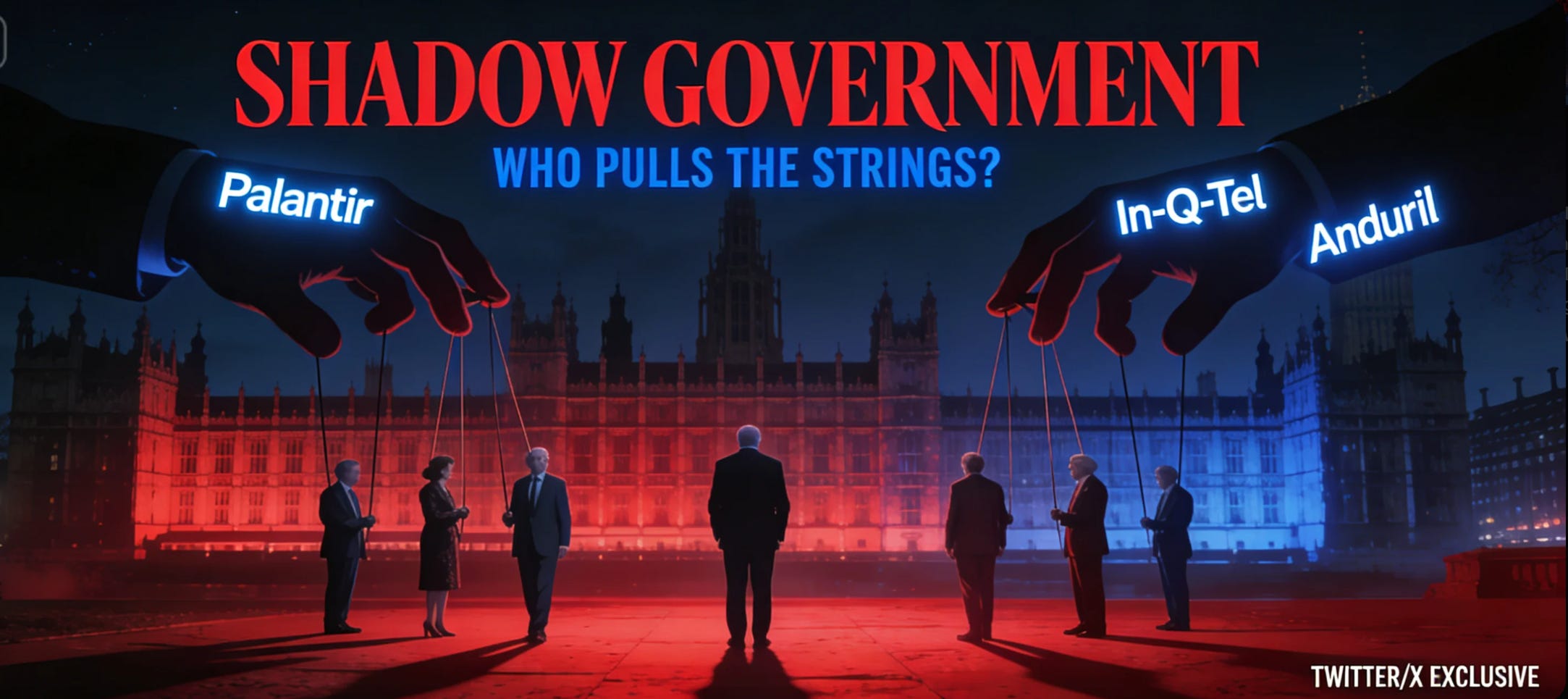
By the end, you will understand who owns the infrastructure of your daily life. Whose money is behind it. Which company has your health records, your military secrets and your phone data. Who built the cameras on every road you drive. Why the people who awarded the contracts then went to work for the companies that got them. And whose venture capital office in London has been quietly shaping all of it.
We were never going to be asked about any of this.
That is the point.
Read one part or read all five. The picture assembles itself either way.
And once you have seen it you cannot unsee it.
THE SERIES
Part One: Flock For Dummies. The road cameras are watching every journey you make. 1
Part Two: They Wanted Everything. The UK government secretly ordered Apple to hand over your encrypted data. Gagged the company. A whistleblower exposed it.2
Part Three: One Pound. Palantir got into the NHS for £1 and left with £900 million. Your health data. Your military secrets. Your nuclear weapons programme. One company. CIA founding money.3
Part Four: The Revolving Door. The people who gave Palantir the contracts now work for Palantir. 32 of them. Two thirds from defence and health. Nobody stopped it.4
Part Five: The Architecture. The CIA’s venture capital arm has a London office. The same network of money connects every company in this series. Nobody voted for any of it.5
6 Sources & Further Reading
Everything they didn’t tell you about the cameras quietly watching every road you drive on
You’ve probably driven past one without knowing it. A small black box on a pole. Solar panel on top. Could be a traffic counter. Could be anything.
It isn’t anything. It’s Flock Safety. And it knows your car, where you’ve been, who you associate with, and when you went to the doctor.
Here’s what it actually is, in plain English.
WHAT IS FLOCK SAFETY?
Flock Safety is an American company founded in 2017. It makes AI-powered cameras and sells them to police departments, local councils, businesses, schools, and neighbourhood associations. Their pitch is simple: help catch criminals, solve crimes, keep communities safe.
As of 2025, Flock operates in over 5,000 communities across 49 US states and performs over 20 billion scans of vehicles every single month.
Twenty billion. Every month.
The company is now worth $7.5 billion and is expanding fast. It is the largest automated licence plate reader network in the country. And it is coming to the UK.
WHAT DOES IT ACTUALLY COLLECT?
Flock’s marketing says licence plates. The reality is considerably more.
These cameras record and analyse every passing vehicle — the make, model and colour of a car, other identifiers like scratches and dents, and anything else they can see. Even a pedestrian, bicyclist, or animal caught in the frame can be swept up in the network. The cameras analyse the recordings using an AI algorithm and upload the data unencrypted to a national surveillance platform.
It doesn’t stop there. The data captured can reveal very private details about a person’s life, including what meetings they attend, what doctors’ offices and religious institutions they visit, who they associate with, and even where they sleep at night.
You haven’t been accused of anything. You haven’t consented to anything. Your car drove past a pole.
DO THEY NEED A WARRANT?
No.
Currently police do not need a warrant to track a licence plate, which raises concerns that it violates the Fourth Amendment — the protection against unreasonable searches and seizures.
In the UK the equivalent protection sits under GDPR and the Human Rights Act. Whether Flock’s deployment here is compliant with either is a question nobody in authority seems to be asking.
CAN YOU SEE YOUR OWN DATA?
No. They won’t let you.
One resident attempted to get his own data from his city’s Flock cameras via a Freedom of Information request, but was told that would violate the police department’s agreement with Flock Safety. He was told his data could only be released if he was the victim of a crime. “When law-abiding members of the public ask to see their own data,” he said, “they are told that a private contract with an out-of-state private corporation overrides their right to know what the government is collecting on them.”
Read that again. A private American company’s contract with your local police department overrides your right to your own data.
WAS THE PUBLIC ASKED?
Generally, no.
In Bartlesville, Oklahoma, the city council approved a contract with Flock Safety to install cameras throughout the city. The move came without a public vote, and community notification occurred only after the decision was finalized.
This is the pattern everywhere. Cameras go up. Public finds out later. By then the contract is signed, the data is flowing, and the network is live.
THE ABORTION CASE
This is the one that should stop everyone cold regardless of where they stand politically.
A sheriff’s office in Texas searched data from more than 83,000 automated licence plate reader cameras to track down a woman suspected of self-managing an abortion. The officer searched 6,809 different camera networks maintained by Flock Safety, including in states where abortion access is protected by law, such as Washington and Illinois. The search record listed the reason plainly: “had an abortion, search for female.”
Electronic Frontier Foundation
She hadn’t been charged with anything. She hadn’t been convicted of anything. A cop typed a reason into a search box and immediately had access to her movements across an entire country.
TRACKING PROTESTERS
The Electronic Frontier Foundation analysed 10 months of Flock searches nationwide and found over 50 federal, state, and local agencies ran hundreds of searches connected to protest activity. In some cases, police specifically targeted known activist groups.
Cameras sold as crime-fighters. Used to monitor people exercising their democratic right to protest.
ICE AND IMMIGRATION
An investigation found ICE indirectly accessed Flock’s system more than 4,000 times between June 2024 and May 2025, through requests routed via local and state law enforcement. This happened even in places that had laws specifically prohibiting cooperation with immigration enforcement.
Flock says it doesn’t work with ICE. The data says otherwise.
WHO OWNS FLOCK?
Flock’s initial venture capital came largely from Peter Thiel’s Founders Fund and several other Thiel-associated firms. Thiel is the same billionaire who co-founded Palantir — the data fusion platform used by the US military, the CIA, and immigration enforcement agencies. Flock’s network can be integrated into predictive policing platforms like Palantir.
The same money. The same ecosystem. One collects the data. The other analyses it.
THE MOMENT THE PUBLIC NOTICED
In February 2026, Amazon ran a Super Bowl ad for their Ring doorbell cameras. The pitch was simple and heartwarming: 10 million pets go missing every year, so Ring built an AI-powered tool that taps into a network of opted-in doorbell cameras to help find lost dogs. The internet didn’t buy it. Within hours, the ad went viral for all the wrong reasons. One TikTok calling the commercial “terrifying” racked up over 3 million views. Senator Ed Markey posted bluntly: “This definitely isn’t about dogs — it’s about mass surveillance.”
In October 2025, Ring had begun a partnership with Flock, planning to link Amazon’s massive consumer camera network directly with law enforcement surveillance infrastructure. The public backlash after the Super Bowl ad was so severe that Ring cancelled the partnership within days.
The dog found them out.
AND NOW IT’S EXPANDING
Flock has rolled out a “drone as first responder” service — where law enforcement can dispatch a drone to evaluate the scene of an emergency call before human officers arrive. Flock’s drone systems completed 10,000 flights in the third quarter of 2025 alone.
Cameras on poles. Cameras on vehicles. Now drones. All feeding the same network. All searchable by any authorised user without a warrant.
SO WHAT’S THE PROBLEM, EXACTLY?
Here it is in one paragraph.
A private American company has built the largest surveillance network in history. It was sold to communities as a crime-fighting tool. It has been used to track a woman who had an abortion, to monitor protesters, to assist immigration enforcement in places that explicitly prohibited it, and to build movement profiles on millions of people who have done nothing wrong. It installed cameras without public votes. It won’t let you see your own data. It is backed by the same billionaires who built the intelligence infrastructure of the modern surveillance state. And it is heading to the UK.
No conspiracy required. Every word of this is documented and sourced.
WHAT YOU CAN DO
Ask your local council whether they have or are planning a Flock Safety contract. Make it a formal written question. They have to answer.
Submit a Subject Access Request under UK GDPR if you believe your data has been collected.
Visit
for a full breakdown of the network and how to push back in your community.
Share this article. The cameras went up quietly. The pushback has to be loud.
How the UK government secretly ordered Apple to hand over your data. And how we only found out because someone leaked it.
Do you have an iPhone?
The UK government secretly ordered Apple to give them everything on it.
Not some of it. Not the bits they had a warrant for. Everything. Every photo. Every message. Every password. Every note. Every backup. Every file stored in iCloud.
And not just yours. Everyone’s. Worldwide. Including Americans. Including people who have never set foot in this country and have no connection to it whatsoever.
And Apple was legally forbidden from telling you it had happened.
That is not a conspiracy theory. That is what occurred. Here is how.
THE SECRET ORDER
In January 2025, the UK Home Office issued what is called a Technical Capability Notice to Apple. A TCN. Most people have never heard of one. That is by design.
A TCN is a secret legal demand issued under the Investigatory Powers Act. The company that receives one must comply with it. They are also placed under a gagging order. They cannot confirm the notice exists. They cannot tell their customers. They cannot make a public statement. They must simply do what they are told and stay silent.
The notice demanded that Apple provide the government with access to all iCloud user data. Not the basic unencrypted stuff. All of it. Including data protected by Apple’s highest level of encryption, a feature called Advanced Data Protection, which Apple designed specifically so that not even Apple itself could access it.
The demand was not limited to UK users. The legal filing confirmed the obligations applied globally in respect of all iCloud users, regardless of where they lived. The UK government had granted itself extraterritorial powers and used them to demand access to the data of people in America, Europe, Australia and everywhere else.
We only found out because a whistleblower leaked the order to the Washington Post in February 2025. Apple was still under the gagging order. They could not confirm it. The government certainly was not going to tell anyone.
WHAT APPLE DID
Apple has said many times that it will never build a backdoor or master key into its products or services.
It meant it.
Rather than build the backdoor the government demanded, Apple withdrew Advanced Data Protection from UK users entirely. Every British iPhone user who had it had it removed. Every new UK user was blocked from activating it.
In a statement, Apple said it was gravely disappointed that the protections provided by Advanced Data Protection were not available to customers in the UK. They said they had never built a backdoor and never would.
So here is where that left every British iPhone user.
Your iCloud data is now less protected than the data of an American user. Less protected than a German user. Less protected than anyone in a country that did not try to order a global tech company to hand over its encryption keys.
The government did not get the backdoor. But it got the next best thing. It stripped the protection away.
THE DEMAND THAT NOBODY KNEW ABOUT
Here is the part that should make your skin crawl.
This happened in January 2025. The gagging order meant Apple could not tell its users. The government was not going to volunteer the information. The only reason you know about it is that someone risked their career, and possibly their freedom, to leak a document to a newspaper.
That is the legal framework this government operates under. Secret orders. Gagging clauses. No public scrutiny. No parliamentary debate. No vote. The Home Secretary signs a piece of paper, and a global technology company is legally obligated to dismantle its own security while staying silent about it.
The Investigatory Powers Act was passed in 2016 under Theresa May. It was updated in 2024 under this government with new powers added. Tech companies must now notify the government before making changes to their products that could affect surveillance capabilities. The government can veto those changes. Apple, or any other company, must ask permission before improving your security.
Read that again.
The government must approve security improvements to your phone.
THE AMERICAN REACTION
When the scale of the demand became clear, the United States was not happy.
Bipartisan anger in Congress. The US Director of National Intelligence, Tulsi Gabbard, confirmed the UK had been pressured to back down, stating the decision protected Americans civil liberties and upheld the principle that neither country should demand access to the other’s citizens data.
It took Donald Trump and JD Vance getting involved to make the UK government retreat from a demand it had made about British citizens on British soil.
Let that land.
The UK government was backed down on its own surveillance policy by another country’s administration because the demand was so overreaching it violated international agreements.
In August 2025, the UK withdrew the original worldwide demand.
In September 2025, it issued a second, revised order. This time targeting only British users.
They did not stop. They narrowed the ask.
WHILE ALL OF THIS WAS HAPPENING
While the government was secretly ordering Apple to hand over your data, it was also suffering some of the largest data breaches in public sector history.
The Legal Aid Agency was hacked. Eighteen years of applicant data exposed. Domestic abuse survivors. Criminal defendants. People in the most vulnerable situations imaginable are having their records compromised.
The Foreign Office was hacked by Chinese state actors.
The MOD Afghan data breach endangered people who risked their lives assisting British forces.
This is the organisation that decided it needed access to your encrypted iPhone data. The organisation that cannot protect the data it already holds is demanding access to more.
And Palantir, the US data analytics company backed by Peter Thiel and integrated with US intelligence infrastructure, has an expanding grip on British government systems that is reportedly raising alarm bells inside the Ministry of Defence itself.
Road cameras are tracking your movements without a warrant. Palantir inside the state. A secret legal order demanding access to your phone. And data breaches that keep exposing the most vulnerable people in the country.
These are not separate stories.
THE QUESTION NOBODY IS ASKING
The Investigatory Powers Tribunal, the secretive court that handles these cases, heard arguments in 2026. Privacy International and Liberty continue to challenge the legal framework. Apple’s Advanced Data Protection is expected to return to UK users now that the worldwide demand was dropped.
But the second order still exists. The legal framework that allowed the first order still exists. The gagging clauses still exist. The government’s power to veto security improvements to your devices still exists.
The question is not whether this government or a future government will use these powers again. They will. The question is whether anyone in a position of power is going to stand up in public and say that a government which secretly orders tech companies to strip your encryption, while losing domestic abuse survivors’ data in hacks, while deploying road cameras without public consent, while integrating with Palantir, has built something that no free people should accept.
That question is waiting for an answer.
How Palantir got into the NHS for £1, and left with your health data, your military secrets, and a contract worth £900 million.
One pound.
That is what Palantir charged for its first NHS contract.
Not one million. Not one thousand. One pound. The price of a bag of crisps. In exchange for access to build a Covid-19 data platform at the height of the pandemic, when there was no time for a proper tender process, and everyone was frightened, and the government was throwing contracts at anyone who could help.
Nobody complained at the time. There was a pandemic. Everybody understood.
That was 2020.
Today, Palantir holds more than £900 million in documented UK public sector contracts. Your health records. Your military operations. The data systems of your nuclear weapons agency. And the government visited their Washington headquarters, accompanied by Lord Mandelson, and took no formal minutes of the meeting.
This is the story of how that happened. And why it matters more than almost anything else in British politics right now.
WHAT IS PALANTIR
Palantir Technologies was founded in 2003 by Peter Thiel, Alex Karp and others. Its seed funding came from the CIA’s venture capital arm, In-Q-Tel. It was built, from the beginning, to do intelligence work. Data aggregation. Pattern recognition. Finding people. Tracking things. The kind of work that intelligence agencies do.
Peter Thiel is a Silicon Valley billionaire, a Trump supporter, a man who has described democracy and freedom as incompatible, and who was one of the most influential voices in the first Trump administration. He is not a passive investor. He is one of the most politically connected figures in American technology.
Palantir’s other major government contracts around the world include work for ICE, the US Immigration and Customs Enforcement agency. The same agency that conducts immigration raids and deportations. Palantir built the data infrastructure that helps ICE find people. Doctors in the UK who treat immigrants have expressed direct concern that patient data on the Palantir NHS platform could, in a different political environment, end up being used in ways patients were never told about.
Switzerland looked at Palantir, considered a military contract, and walked away. An official Swiss Army report cited fears that confidential data could be accessed by the CIA and NSA. Palantir disputes the report.
Switzerland still walked away.
The UK kept going.
THE TIMELINE
Palantir gets a £1 NHS contract. Nobody notices.
That £1 contract becomes a £330 million deal for something called the NHS Federated Data Platform. The FDP. A system connecting data across up to 240 NHS organisations. Beds. Waiting lists. Staffing rosters. Discharge information. Patient records. The most sensitive health data in the country, brought together on a single platform built and run by a company that started with CIA money.
The contract was released publicly with 417 of its 586 pages completely blanked out.
December 2025. The Ministry of Defence awards Palantir a £240.6 million contract for data analytics capabilities supporting critical strategic, tactical and live operational decision making across classifications. In plain English: they are inside military operations now.
The contract was awarded without competitive tender.
Also in 2026, an investigation by journalist Carole Cadwalladr revealed a previously unknown £15 million contract between Palantir and AWE Nuclear Security Technologies. Formerly known as the Atomic Weapons Establishment.
Palantir is inside the NHS. Inside the MOD. Inside the nuclear weapons agency. And the total documented value of UK contracts now exceeds £900 million. The investigation noted that the true figure is likely higher. Multiple contracts remain unacknowledged or heavily redacted.
THE MEETING WITH NO MINUTES
On 27 February 2025, Lord Mandelson accompanied Prime Minister Keir Starmer on a visit to Palantir’s Washington headquarters.
No formal minutes were taken.
Defence Minister Luke Pollard was asked directly about the missing minutes in parliament. He did not deny their absence.
The Prime Minister of the United Kingdom visited the headquarters of a company holding £900 million in public contracts, a company that holds your health data and military operational data, and nobody wrote down what was discussed.
This is the government that told you it would be transparent. That it would end the era of dodgy dealing and insider arrangements. That it would be different.
No minutes.
THE DOCTORS ARE WORRIED
On 11 February 2026, the British Medical Association, representing over 200,000 doctors, urged its members to immediately take steps to explore refusing any non-direct care usage of Palantir’s Federated Data Platform.
BMA Chair Tom Dolphin called for a complete break from Palantir technologies in the NHS, citing the company’s ICE immigration enforcement work as a direct threat to patient trust.
Over 47,000 patients have formally opposed the platform.
Two MOD engineers have described the Palantir enterprise agreement as a national security threat.
These are not fringe voices. The body representing every doctor in the country is asking its members to refuse to use it. The people inside the Ministry of Defence who understand what the contract actually means are calling it a threat to national security.
And the government has not cancelled it.
THE CRITICAL DECISION
The NHS contract follows a 3+2+1+1 structure. The first three-year term ends in March 2027. If the government does not actively trigger the first extension this year, the contract ends.
2026 is the decision year.
Health Minister Zubir Ahmed said in April 2026 that the government will decide later this year whether to extend. He said it could end if other firms can perform better. He did not say it would end. He said the government would look at it.
After the BMA intervention. After 47,000 patient objections. After the Swiss Army walked away. After the MOD engineers raised the alarm. After the meeting with no minutes. After £900 million. After the nuclear contract nobody knew about.
They are going to have a look at it.
WHAT NOBODY HAS NHS OWNS AFTER £330 MILLION
Here is the part that should make anyone who pays taxes quietly furious.
After spending £330 million of public money on the NHS Federated Data Platform, the NHS owns no software. No intellectual property. Nothing.
When the contract ends, if it ends, the platform goes back to Palantir. The data infrastructure built at public expense, running on public data, belongs to a private American company with CIA founding money and contracts with the Trump immigration enforcement agency.
You paid for it. You own none of it.
THE CONNECTED PICTURE
We told you about the Apple story. How the government secretly ordered Apple to hand over your encrypted phone data. How it took a whistleblower and American diplomatic pressure to make them back down. How they then issued a second, revised order.
Here is what that story and this one have in common.
The government is demanding access to your private encrypted data while simultaneously handing your health data to a US intelligence company, your military data to the same company, and your nuclear data to the same company, without competitive tender, with meetings that have no minutes, with contracts that are blacked out, while the people inside the institutions are raising the alarm.
This is not two stories. It is one story.
A government is building a surveillance infrastructure on one side while handing data sovereignty to American tech companies on the other. Secret orders. Gagging clauses. No minutes. Redacted contracts. And the people who actually understand what is happening are being ignored.
THE REVOLVING DOOR
At what point does a pattern stop being coincidence and start being a system?
You know that Palantir got into the NHS for £1, walked out with a £330 million contract, then picked up another £240 million from the Ministry of Defence without competitive tender. You know the total documented figure now exceeds £900 million. You know the BMA representing 200,000 doctors called for a complete break from the company. You know MOD engineers called it a national security threat.
Here is the question that piece did not answer.
Why does a company with that level of documented opposition keep getting bigger contracts.
The answer was published six weeks ago. Most people missed it.
THE REVOLVING DOOR
Palantir has hired more than 32 senior UK government and public sector officials.
Not interns. Not junior staff. Senior officials. The people who were inside the institutions that Palantir now has contracts with.
Over two thirds of those hires came from two areas. Defence. And health. Exactly the two areas where Palantir holds its largest UK contracts.
Here is what that looks like in practice.
Indra Joshi was NHS England’s head of AI. Not a minor role. She ran the formation of the NHS artificial intelligence lab. She oversaw the creation of data infrastructure during the pandemic. She was the single most important person in the NHS when it came to decisions about AI and data. In 2022 she left. She became Palantir’s director of health, research and AI.
Paul Howells was head of NHS Wales’s national data programme. He became Palantir’s director of health and care.
These are not the only examples. There are thirty two documented cases. Two thirds of them from the same two departments that hold the contracts.
WHAT AMERICANS CALL THIS
In the United States this has a name. The revolving door. It is as old as Washington DC itself.
Defence Secretary leaves. Goes to Lockheed Martin. Lockheed gets the contract. The people who know where the bodies are buried, who knows which officials to call, who understands the procurement process from the inside, become the most valuable employees a defence contractor can hire.
It is not always illegal. It is sometimes technically within the rules. But it is how public money flows toward private hands, and it is how decisions get made that look surprising on paper but make complete sense when you know who just got hired.
The British version of this is called the revolving door too, though the British political class prefers not to use the phrase. The Advisory Committee on Business Appointments is supposed to regulate it. It has very limited powers and very limited teeth.
Palantir hired the NHS’s head of AI while the NHS AI contract was running. The person who shaped the NHS’s thinking about data and AI, the person whose institutional knowledge was most valuable to a company trying to expand its NHS footprint, went directly to that company.
Nobody stopped it.
WHY THIS MATTERS
Here is what the revolving door actually does.
It is not primarily about corruption in the conventional sense. It is about information asymmetry. The company that hires ex-officials does not just get their skills. It gets their contacts. Their understanding of how decisions are made. Their knowledge of which objections matter and which can be managed. Their access to the conversations that happen before the formal procurement process begins.
The BMA raised concerns. 47,000 patients objected. MOD engineers raised the alarm. The Swiss Army walked away.
The contracts kept growing.
When the people who understand the procurement process from the inside are working for the company seeking the contracts, the people raising concerns are always starting from behind. They are arguing in public. The other conversation is happening in private, between people who used to work together, in language the objectors cannot fully access.
That is what 32 hires buys you. Not a bribe. An advantage.
THE MAN BEHIND IT
Peter Thiel co-founded Palantir. He sits on its board. His venture capital fund Founders Fund also invested in Flock Safety, the road camera network covered in Part Three of this series.
Since Trump’s return to the White House, Palantir has become central to American state power. Its software underpins ICE immigration enforcement and through work with the Department of Government Efficiency helped create what critics call America’s first searchable citizen database. It also supports US military AI systems being used in Venezuela, Gaza and Iran.
Thiel was on Trump’s transition team. He is one of the most politically connected figures in the tech world on either side of the Atlantic.
His company has £900 million in UK contracts. His company has hired the people who ran the UK’s health and defence data programmes. His company operates inside the UK’s nuclear weapons agency. And the Prime Minister of the United Kingdom visited his company’s Washington headquarters with Lord Mandelson and did not take minutes.
THE AMERICAN PARALLEL AND WHY IT MATTERS TO YOU
Americans reading this will find it familiar because it is familiar.
The military industrial complex Eisenhower warned about in 1961 did not stop at the Pentagon. It expanded into healthcare, into technology, into intelligence. The same pattern. Public contracts. Private profit. Officials moving between the two. Decisions made in rooms nobody was watching.
What is happening in Britain right now is the same infrastructure being built on the other side of the Atlantic. The same company. The same investor. The same revolving door. The same absence of competitive tender. The same resistance to scrutiny.
The difference is that Americans have had fifty years to learn what this looks like. Brits are learning in real time.
The people who used to run your health data now work for the company that holds it.
The people who used to run your military data now work for the company that has it.
And the company was founded by the man who is one of the most powerful figures in the Trump administration.
That is not a conspiracy theory. Every word of it is documented and sourced.
THE QUESTION NOBODY IS ASKING IN PARLIAMENT
The Advisory Committee on Business Appointments should have scrutinised these moves. Whether it did and whether its advice was followed is not publicly clear in all cases.
What is clear is the outcome. Thirty two hires. Two thirds from defence and health. Contracts that keep growing despite documented opposition from doctors, engineers, patients and allied governments.
At what point does a pattern stop being coincidence and start being a system.
That question deserves an answer in parliament. It has not yet been asked loudly enough.
THE THING ABOUT REVOLVING DOORS
Most people imagine power as something dramatic.
A vote in parliament.
A minister standing at a podium.
A contract announcement.
Power rarely looks like that.
Most of the time it looks like a goodbye email.
A leaving party.
A new business card.
One person walks out of a public office. A few months later they walk into a private company. The knowledge goes with them. The contacts go with them. The understanding of how the system works goes with them.
The public never gets invited to that meeting.
That is why the revolving door matters.
Not because every person who walks through it is corrupt.
Because every time it spins, the same people end up on both sides of the table.
The NHS patient is not in the room.
The taxpayer is not in the room.
The soldier whose operational data sits inside these systems is not in the room.
But the contractors are.
Again.
And again.
And again.
That is what this series is really about.
Not Palantir.
Not Apple.
Not road cameras.
Power.
Who has it?
Who keeps it?
And who is expected to live with the consequences?
The next piece connects all four stories.
Because they are not four stories.
They are one.
The same money. The same network. The same absence of accountability.
It has a name. Most people have not heard it yet.
THE ARCHITECTURE
Nobody voted for this. Nobody was asked.
You know about the cameras on every road that track your movements without a warrant. You know about the secret government order that stripped encryption from every British iPhone. You know about the American company that got into the NHS for £1 and walked out with £900 million. You know about the 32 senior officials who awarded the contracts and then went to work for the company that got them.
Here is the question those four articles were building toward.
What do they have in common.
Not the companies. Not the contracts. Not the officials.
The money behind them.
THE ORGANISATION MOST PEOPLE HAVE NEVER HEARD OF
In-Q-Tel was founded in 1999. It is a private nonprofit venture capital firm. It is funded by the Central Intelligence Agency. Its stated mission is to identify and invest in technology companies whose products serve the needs of the US intelligence community.
It has made more than 800 investments. Hundreds of them are classified.
It has offices in Arlington Virginia. Menlo Park California. Cambridge Massachusetts. Sydney. Singapore. Munich.
And London.
The CIA’s venture capital arm has a physical office in London. That is not a claim. That is documented on their own website, which lists London as an active office location alongside its American headquarters.
In-Q-Tel opened its London office in 2018 with a public statement explaining the reason: to strengthen its ability to reach startups and the venture capital community outside the United States and to better contribute to the national security of the US and its allies.
Their own website also states that In-Q-Tel’s work has produced solutions for the CIA, NSA, FBI, DIA, NRO, DHS and the UK and Australian national intelligence communities.
The US intelligence community’s investment arm is operating in Britain. Working with British intelligence. Identifying British technology companies. And the British public has largely never been told.
WHAT IN-Q-TEL FUNDED
The original investment in Palantir came from In-Q-Tel. The company that now holds your health records, your military data, and your nuclear weapons programme data was seeded with CIA money. That investment has since been exited. But the relationship between Palantir and the US intelligence community did not end when In-Q-Tel sold its shares.
In-Q-Tel also invested in Anduril. The investment came four months after the company was founded in April 2017.
But In-Q-Tel does not only fund surveillance and weapons companies. This matters and the article would be dishonest not to say it.
Infleqtion is also an In-Q-Tel portfolio company. It delivered the UK’s first 100-qubit quantum computer to the National Quantum Computing Centre at Harwell in 2025, meeting the UK government’s own national strategy target. It has conducted Royal Navy sea trials of its quantum atomic clock aboard the MOD’s Excalibur submarine. It is now building a Quantum Innovation Centre at Oxford Technology Park.
That is genuine, beneficial technology serving real British defence and research interests.
The point of this article is not that In-Q-Tel is evil. It is that the British public has not been told that the CIA’s venture capital arm has a London office, is embedded in British quantum research, British military drone programmes, British health data and British road surveillance simultaneously, and that none of this has been subject to meaningful public scrutiny or democratic debate.
The technology may be beneficial or harmful or both. The point is that nobody asked you.
ANDURIL — THE COMPANY COMING TO A FIELD NEAR YOU
Anduril Industries was founded in April 2017 by Palmer Luckey, the man who built Oculus and sold it to Facebook for $2 billion. Its other co-founders include Trae Stephens, who worked at Palantir Technologies before joining Peter Thiel’s Founders Fund venture capital firm and then co-founding Anduril.
The UK government has awarded Anduril at least £62 million in contracts since 2021. A further £30 million was announced in March 2025.
Anduril’s AI powered surveillance tools have already been deployed by the UK Home Office as part of the Stop the Boats strategy, tracking small vessel crossings in the English Channel.
There was no public vote on this. There was no parliamentary debate. British waters are now monitored by the surveillance systems of a company backed from its earliest months by the CIA’s venture capital arm.
Anduril is now bidding for a £100 million British Army contract called Project NYX for a next generation autonomous combat aircraft. Bloomberg reported in December 2025 that the company is billing itself as an Anglo-American company to win UK military work, and has offered to co-fund half the development cost.
Anduril is planning to build a drone manufacturing facility in Britain, either in the northwest of England or within the Oxford-Cambridge arc, modelled on its $1 billion production hub in Ohio.
The partnership signing ceremony between Anduril UK and GKN Aerospace took place at GKN’s facility in Cowes on the Isle of Wight in December 2025.
A company backed by CIA venture capital from its earliest months is building a permanent manufacturing presence in Britain. It is already tracking people crossing the Channel. It is bidding for contracts that will put autonomous combat aircraft in British military operations. And it is doing all of this with the same absence of public debate that has characterised every other company in this series.
THE MANDELSON THREAD
This is the part that connects the network directly to the Prime Minister’s office.
Peter Mandelson co-founded Global Counsel, a political lobbying firm, after Labour lost the 2010 election. In 2018, Palantir hired Global Counsel specifically to help procure UK government contracts. Mandelson held a 24% stake in the firm.
Palantir secured the £330 million NHS contract. Then the £240 million MOD contract.
In January 2025, Starmer appointed Mandelson as UK Ambassador to the United States. The due diligence vetting process reportedly missed the Global Counsel and Palantir connection entirely.
On 27 February 2025, Mandelson accompanied the Prime Minister to Palantir’s Washington headquarters. The meeting did not appear in the Prime Minister’s register of official visits. It only came to light later. No minutes were taken.
At the time of the visit, Palantir was still a client of Global Counsel.
In December 2025, ten months after the unminuted Washington meeting, the government signed a £250 million MOD contract with Palantir.
An Early Day Motion condemning the lack of transparency around the Palantir NHS contracts was signed by 23 MPs. Conservative MP Alex Burghart said publicly that for there not to be an official record when the person who organised the meeting potentially had a business interest is outrageous. Liberal Democrat leader Ed Davey called for a formal investigation.
Leicestershire Police also signed a contract with Palantir worth close to £1 million for an intelligence and investigation platform. No formal tender process was used.
The lobbying firm that helped Palantir win UK government contracts was co-founded by the man who then became UK Ambassador and accompanied the Prime Minister to Palantir’s headquarters. The meeting was not minuted. The contracts kept growing.
Nobody has been found to have broken the law. That is what makes it worse, not better.
THE THIEL THREAD
Peter Thiel co-founded Palantir in 2003. In-Q-Tel was among its earliest investors.
His venture capital fund Founders Fund backed Flock Safety, the road camera network covered in Part One of this series.
Trae Stephens, Anduril’s co-founder and chairman, worked at Palantir and then at Founders Fund before co-founding Anduril.
Thiel was on Donald Trump’s transition team in 2016 and remains one of the most politically connected figures in the current administration.
Palantir’s work with the Department of Government Efficiency helped create what critics describe as America’s first searchable citizen database, aggregating data on American residents across multiple government systems.
The same company holding your NHS records and your MOD operational data is building a database of American residents for the Trump administration.
That is not a connection drawn by inference. It is documented by multiple news organisations.
THE MAP
Draw it out.
Your car drives past a Flock Safety camera. Thiel money. Data shared with law enforcement without a warrant. Integrated with Palantir.
Your health records sit on a Palantir platform. CIA founding investment. 32 revolving door officials. No competitive tender. No parliamentary vote.
Your military operations are analysed by Palantir. Same company. Same money. Same absence of public scrutiny.
Your nuclear weapons data is managed on a Palantir system. Same company. A £15 million contract that was not publicly acknowledged until an investigation found it.
The English Channel is monitored by Anduril surveillance systems. CIA backed from its earliest months. Co-founded by a former Palantir and Thiel employee. Planning a permanent UK manufacturing base.
Your iPhone lost its highest level of encryption because the UK government secretly ordered Apple to remove it. The government was legally prohibited from telling you. You found out because a whistleblower leaked to a newspaper.
The Prime Minister visited a company’s Washington headquarters without taking minutes, accompanied by a man whose lobbying firm had that company as a client. Ten months later the company got a £250 million contract.
These are not separate stories about separate companies making separate decisions.
They are components of the same infrastructure.
WHAT NOBODY VOTED FOR
Here is the question at the centre of all five articles.
When did you vote for this.
Not legally. Democratically. When did a politician stand in front of you and say: I want to hand your health data to a company with CIA founding investment. I want to track every vehicle you drive past cameras that upload to a national network without a warrant. I want to give a CIA backed company a permanent military manufacturing presence in Britain. I want to secretly order Apple to remove your phone encryption and legally prevent them from telling you about it. I want to visit a company’s headquarters with the man whose lobbying firm represents it and not write any of it down.
Nobody said that. Nobody asked.
The decisions were made in procurement meetings. In Washington headquarters where no minutes were taken. In contracts with 417 of 586 pages blacked out. In secret orders with gagging clauses attached. In revolving door appointments that technically followed the rules. In lobbying relationships that were not fully declared.
All of it legal. All of it documented. None of it put to the people it was done to.
THE WORD FOR THIS
There is a word for when the same network of money and people builds infrastructure that serves power without asking permission from the people whose lives it shapes.
It is not a conspiracy. Conspiracies are secret. This is in the public record. It is in freedom of information disclosures, in Companies House filings, in parliamentary answers, in the In-Q-Tel website, in the NHS contract documents, in the Anduril press releases, in the parliamentary register of interests, in the Hansard record of debates that have already happened.
The word is capture. Regulatory capture. Institutional capture. The process by which the systems that are supposed to serve the public interest are quietly reshaped to serve the interests of the people who fund them.
It does not require a secret meeting in a basement. It requires money, patience, and the absence of anyone asking the right questions loudly enough.
WHAT COMES NEXT
In-Q-Tel has more than 800 investments. Hundreds are classified. Its London office is active. It works directly with UK intelligence services.
Anduril is building in Britain.
Palantir’s NHS contract comes up for extension decision in 2026. This year.
The Apple order is under legal challenge. A second order targeting British users specifically is still active.
Flock Safety is expanding into the UK market.
The Mandelson connection to the £250 million MOD contract has been raised in parliament. No inquiry has been announced.
The architecture is not finished.
It is being built right now.
With your money.
Around your life.
Without your knowledge.
The question is not whether it exists.
The question is whether anyone is prepared to talk about it before it is finished.
Because once the cameras are installed, once the contracts are signed, once the databases are connected and once the infrastructure becomes normal, nobody calls it new anymore.
They call it the way things are.
And that is how permanent things happen.
Not with a vote.
Not with a debate.
Not even with a headline.
One decision at a time.
One contract at a time.
One compromise at a time.
Until one day you wake up inside something nobody remembers building.
A NOTE ON SOURCES AND INTERPRETATION
Parts One through Four of this series dealt with specific documented events. Specific contracts. Specific companies. Specific officials. Specific dates. Every claim was sourced and verifiable.
Part Five does something different. It connects those events into a broader picture.
That connection is the author’s interpretation. The facts are documented. The pattern they form is a conclusion drawn from those facts. Readers who are sceptical of that conclusion are right to ask where the evidence ends and the interpretation begins.
Here is that line clearly stated.
What is documented fact: In-Q-Tel funded Palantir. In-Q-Tel funded Anduril. In-Q-Tel has a London office. In-Q-Tel explicitly states it works with UK intelligence services. Anduril has £62 million plus in UK contracts. Palantir has £900 million plus in UK contracts. Flock Safety is Peter Thiel backed. Trae Stephens worked at Palantir and Founders Fund before co-founding Anduril. The Mandelson-Palantir lobbying connection existed. The Washington meeting happened without minutes. The £250 million MOD contract followed. 32 officials moved from government to Palantir. The Apple backdoor order was issued and gagged.
What is the interpretation: That these connections form a coherent infrastructure rather than a series of separate decisions. That the people involved are acting with unified intent. That the outcome is the result of a conscious strategy rather than overlapping interests arriving at similar conclusions through separate decisions.
The author believes the pattern is significant enough to warrant public debate regardless of which interpretation is correct. The facts alone justify that debate. The interpretation is offered as a framework for understanding them, not as established truth.
Read the sources. Draw your own conclusions. The documents are all in the public record.
Sources & Further Reading
Civil Liberties, Local Reporting & Tech Accountability
ACLU Oregon; ACLU of Massachusetts (Flock Safety); Electronic Frontier Foundation; EFF Flock Safety investigation; 404 Media; Truthout; Colorado Sun; Ohio Atomic Press; Berkeley Side; InvestigateTV; Business and Human Rights Resource Centre; TechCrunch; CNN Business.
Telecoms, TCNs & Government Surveillance
Washington Post – original TCN leak (Feb 2025); Apple statement on Advanced Data Protection withdrawal (Feb 2025); UK Investigatory Powers Tribunal filings (2025–2026); Tulsi Gabbard DNI statement (Aug 2025); Financial Times reporting on second TCN (Oct 2025); Privacy International legal challenge documentation; Hedgehog Security – UK government breach report (Apr 2026); AOAV Palantir/MOD report (Mar 2026).
NHS, Defence Data & Public Sector Procurement
Medact Palantir briefing (Mar 2026); The Nerve – Carole Cadwalladr investigation (Feb 2026); Slow AI Substack investigation (Mar 2026); Hansard – Defence Minister’s response on meeting minutes; BMA statement (Feb 2026); NHS England contract explainer (Apr 2026); Westminster Hall debate (16 Apr 2026); Swiss Army internal report (multi‑source cited).
Revolving Doors, Corporate Filings & Oversight
The Nerve – revolving door investigation (Apr 28 2026); The Nerve – original contracts investigation (Feb 2026); AOAV Palantir/MOD report (Mar 2026); Medact Palantir briefing (Mar 2026); Advisory Committee on Business Appointments public register; Palantir Technologies UK – Companies House filings.
Defence Contractors, Anduril, In‑Q‑Tel & Emerging Tech
In‑Q‑Tel official website & office listing; In‑Q‑Tel London office announcement (Nov 2018); AOAV investigation into Anduril UK contracts (Jul 2025); Bloomberg investigation into Anduril UK strategy (Dec 2025); Flight Global – Project NYX reporting (Dec 2025); Byline Times – FOI disclosures on Anduril; The Nerve – revolving door investigation (Apr 2026); The Nerve – Palantir contracts investigation (Feb 2026); Medact Palantir briefing (Mar 2026); Foxglove – Mandelson/Palantir campaign (Feb 2026); Hansard – Palantir MOD debate (10 Feb 2026); LBC – parliamentary Mandelson/Palantir questions (Mar 2026); Keep Our NHS Public – Mandelson/Palantir briefing (Feb 2026); Early Day Motion 65316 – Palantir & the NHS (2024–26 session); Washington Post – original TCN leak (Feb 2025); Apple statement on ADP withdrawal (Feb 2025); Infleqtion UK expansion announcement (May 2026).
Key Multi‑Group Sources
AOAV Palantir/MOD report (Mar 2026); Medact Palantir briefing (Mar 2026); The Nerve investigations (contracts, revolving door); Washington Post – TCN leak (Feb 2025); Apple ADP withdrawal statement (Feb 2025).